
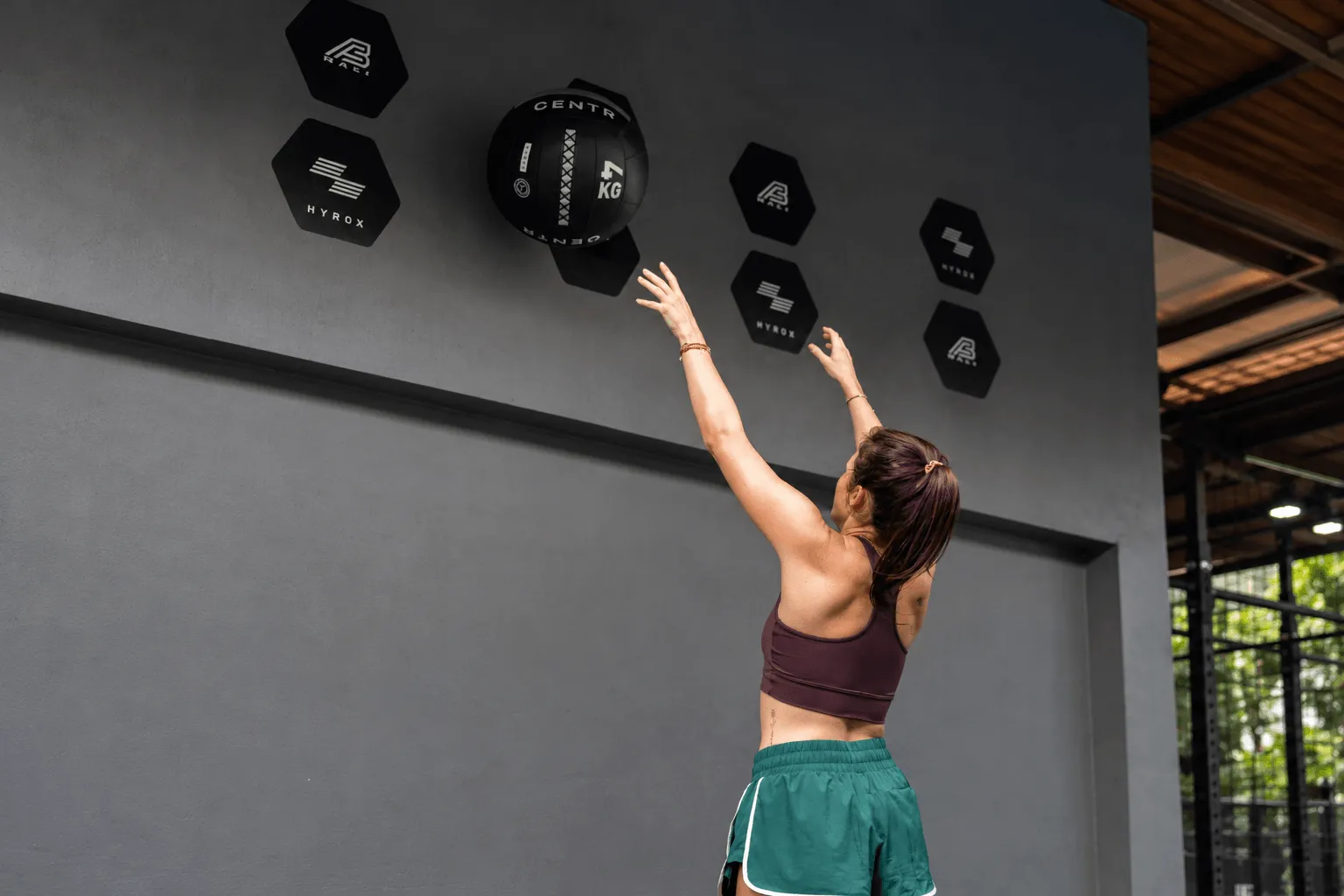
You’ve made it through the runs, sleds and burpee broad jumps. Then comes the final 100 reps: wall balls.
The weight you need depends on your HYROX division, with different standards for Open, Pro and Doubles. Getting familiar with the right HYROX wall ball weight before race day helps you train with the same load, practice the correct target height and build a strategy for those final reps.
Here’s a breakdown of the HYROX wall ball weight by division, including the target height, rep count and race standards you need to know.*
*All weights, target heights and movement standards are based on the official HYROX Rulebook. Read the full HYROX Rulebook (2026/2027)
What is the HYROX wall ball weight by division?
The HYROX wall ball weight depends on the division you enter. While every Singles division completes 100 wall balls, the weight increases from Open to Pro.
Division | Wall ball weight | Target height | Wall balls |
Women Open | 4 kg | 2.70 m | 100 |
Men Open | 6 kg | 3.00 m | 100 |
Women Pro | 6 kg | 2.70 m | 100 |
Men Pro | 9 kg | 3.00 m | 100 |
The current HYROX 2026/27 Singles standards set the wall ball weight at 4 kg for Women Open, 6 kg for Men Open and Women Pro, and 9 kg for Men Pro. The target is 2.70 m for women and 3.00 m for men.
That means the difference between Open and Pro isn't the number of reps or target height. Pro athletes use a heavier wall ball.
How much does the HYROX wall ball weigh in each division?
The weight changes depending on your division, so make sure you’re training with the same ball you’ll use on race day. Here’s what to expect in each category.
Women Open
Women Open athletes use a 4 kg wall ball and throw it to a 2.70 m target for 100 reps.
The 4 kg ball is the lightest wall ball weight used in the Singles divisions, but 100 reps still require controlled movement and consistent pacing, especially at the end of the race.
Men Open
Men Open athletes use a 6 kg wall ball with a 3.00 m target for 100 reps.
The higher target and heavier ball make it important to practice the full movement at race height, rather than relying only on standard wall ball training.
Women Pro
Women Pro athletes use a 6 kg wall ball and a 2.70 m target for 100 reps.
Compared with the Women Open, the target stays the same but the ball is 2 kg heavier. If you're moving up to Pro, that extra load is something to account for in your training.
Men Pro
Men Pro athletes use a 9 kg wall ball and throw to a 3.00 m target for 100 reps.
This is the heaviest wall ball standard in HYROX Singles. Training with the race weight gives you a better idea of how the movement will feel when you reach the final station.
Continue reading: Everything you need to know about HYROX gear
What about HYROX Doubles and Mixed Doubles?
Doubles changes how the 100 wall balls are shared, but the wall ball weight still depends on the division. Mixed Doubles follows a slightly different setup: both partners use a 6 kg wall ball, with each athlete throwing to their own target height.
Doubles division | Wall ball weight | Target height | Total wall balls |
Women Doubles | 4 kg | 2.70 m | 100 |
Men Doubles | 6 kg | 3.00 m | 100 |
Mixed Doubles | 6 kg | 2.70 m women / 3.00 m men | 100 |
Women Pro Doubles | 6 kg | 2.70 m | 100 |
Men Pro Doubles | 9 kg | 3.00 m | 100 |
In Doubles, the 100 wall balls are completed between both athletes, so you can divide the reps between you according to your race strategy. In Mixed Doubles, both athletes use the 6 kg ball, but each uses the target height for their gender.
That makes it worth practicing your transitions before race day. You want to know not only how many reps you can handle, but also when to switch without losing time.
What is the HYROX wall ball target height?
The HYROX wall ball target height depends on whether you’re racing in a men’s or women’s division. The height stays the same between Open and Pro, so the main change when moving to Pro is the weight of the wall ball.
- Women: 2.70 m
- Men: 3.00 m
The wall ball must make contact with the designated target at the required height for the rep to count.
This is worth practicing at the same height you’ll see in competition. A wall ball can feel very different when you have to hit a higher target consistently, especially after the running and earlier HYROX stations.
What are the HYROX wall ball standards?
Getting the HYROX wall ball weight right is only part of the preparation. Your reps also need to meet the race standard.
For each wall ball rep, focus on:
- Start position: Stand tall with your hips and knees fully extended.
- Squat depth: Lower into a full squat with your hips below your knees.
- Throw: Throw the ball with both hands toward the designated target.
- Target: The ball must hit the required target height for your division.
- Repeat: After the ball comes back down, complete the next rep according to the movement standard.
That means practicing with the right weight isn't enough. Your squat depth, throw and target height all need to be consistent if you want your reps to count.
For training, use the same weight and target height as your race division whenever possible. It gives you a much better feel for what 100 valid reps will actually require.
Continue reading: HYROX Rules: Race format, stations, penalties & competition standards
How should you train for HYROX wall balls?
The goal isn't just to be able to throw the right HYROX wall ball weight. You need to keep your reps controlled when you reach the final station.
Focus your training on three things:
- Use your race weight: Practice with the same wall ball you’ll use on race day so the load feels familiar.
- Practice the target height: Set your target to the official 2.70 m or 3.00 m height for your division. This helps you build consistency with every throw.
- Build sustainable sets: Start with manageable sets rather than always trying to complete all 100 reps unbroken. Find a rhythm that lets you maintain your squat depth and target accuracy.
Train wall balls under fatigue
Wall balls feel different when you're fresh compared with the end of a HYROX race. Add them after running, sled work or other functional movements to practice keeping your technique when you're already tired.
You can also practice different rep combinations with a partner if you're preparing for Doubles. The aim is to make your transitions quick and keep both athletes moving.
Train the movement as it will happen on race day. That means the right weight, the right target height and plenty of practice when you're not fresh.
Train for HYROX at Body Factory Bali
Training for HYROX takes more than knowing the standards. You need the right space, the right equipment and the chance to put your training to work.
Ready to put your HYROX training to work?
At Body Factory Bali, you can train for HYROX with the space, equipment and training environment to put those race standards into practice. Know the standard. Train for it. Then show up ready.
Train for HYROX at Body Factory Bali
FAQ
Can I use a heavier wall ball when training for HYROX?
You can, but your main training should still include the official race weight for your division. A heavier ball can be useful for strength work, but it doesn't replace practicing with the load you'll use in competition.
Should I practice wall balls unbroken for HYROX?
Not necessarily. Being able to complete 100 reps unbroken is useful, but your training should also include smaller sets and short breaks. This lets you test different pacing strategies and find an approach you can maintain late in the race.
How can I practice HYROX wall balls at home?
If you have enough space and a suitable medicine ball, you can practice the squat and throw movement. For the most race-specific preparation, however, you'll want access to the correct wall ball weight and target height for your division.
Why do HYROX wall balls feel harder than normal wall balls?
The movement itself isn't necessarily different from a standard wall ball exercise. The difference is when you perform it. In HYROX, you reach the station after running and completing multiple functional exercises, so you're performing the final 100 reps under fatigue.
How do I avoid no-reps on HYROX wall balls?
Practice the full movement consistently rather than focusing only on speed. Make sure you reach the required squat depth and hit the designated target on every rep. Training with a coach or using video feedback can also help identify technical issues before race day.