
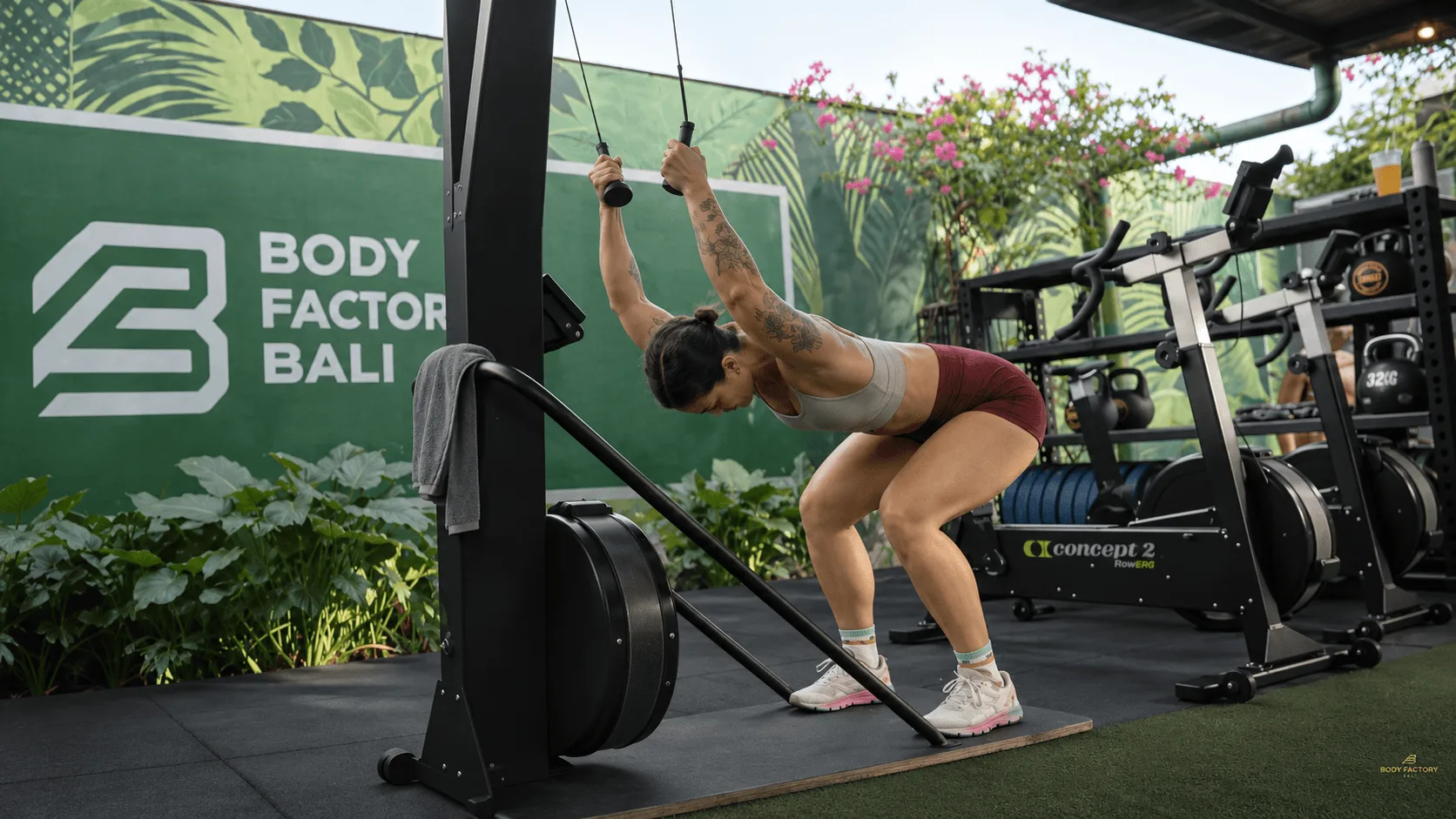
The cable fly is a chest isolation exercise performed using a cable machine. It trains the chest muscles through a controlled arc, bringing the arms together in front of the body against resistance.
Unlike a bench press, which involves significant assistance from the triceps, the cable fly emphasizes horizontal shoulder adduction, the movement of the upper arms toward the center of the body. This makes it a useful addition to a chest workout focused on muscle hypertrophy, muscular control, and balanced resistance training.
The cable machine also allows you to adjust the pulley height, change your body position, and select different movement angles. These adjustments make the cable fly exercise versatile enough to complement a range of strength training programs.
What muscles does the cable fly work?
The cable fly primarily targets the pectoralis major, the large muscle responsible for many of the chest's pushing and inward arm movements.
Other muscles contribute to the exercise:
- Pectoralis major: The primary target, responsible for bringing your upper arms toward the midline.
- Anterior deltoids: The front shoulder muscles assist with arm movement, particularly when the arms travel forward and inward.
- Serratus anterior: Helps control the shoulder blades during upper-body movement.
- Core muscles: Help stabilize your torso, particularly during standing variations.
Changing the cable angle can emphasize different regions of the pectoralis major. A low-to-high movement places greater emphasis on the clavicular, or upper chest, region, while a high-to-low movement emphasizes the sternocostal fibers, which contribute substantially to the middle and lower chest.
However, no cable fly variation isolates a single chest region completely. The chest works as a coordinated muscle group, and overall development depends on your training volume, exercise selection, and progression.
Continue reading: How often should I go to the gym? A realistic guide based on your goals
How to do a cable fly with proper form
The standing cable fly is a practical starting point for learning the movement. Use a weight that allows you to control every repetition without relying on momentum.
Step 1: Set up the cable machine
Position the pulleys at approximately shoulder height. Attach a handle to each side and select a manageable weight. Check that the equipment is secure before starting.
Step 2: Establish your stance
Stand in the center of the machine and take a small step forward. Use a staggered stance for stability, brace your core, and keep your torso upright.
Step 3: Position your arms
Hold one handle in each hand with your arms extended out to the sides. Keep a slight bend in your elbows and maintain a neutral wrist position. Avoid locking your elbows.
Step 4: Bring your hands together
Pull both handles forward in a controlled arc until your hands meet or approach each other in front of your chest. Focus on moving your upper arms inward rather than turning the exercise into a press.
Step 5: Squeeze your chest
Pause briefly at the point of contraction. Maintain control instead of forcing your hands together or rounding your shoulders excessively.
Step 6: Return to the starting position
Slowly allow your arms to move outward as the cables pull them back. Stop when you reach a comfortable stretch without losing shoulder control.
Repeat for the desired number of repetitions.
Best cable fly variations for chest development
Adjusting the pulley height changes the direction of resistance and the path of your arms. Choose variations that support your training goals rather than performing every variation in the same session.
1. Standing cable fly
Best for: General chest development.
Set the pulleys around shoulder height and bring the handles together in front of your chest. This standard cable chest fly is a straightforward option for training the pectoralis major through a controlled range of motion.
2. Low-to-high cable fly
Best for: Emphasizing the upper chest.
Set the pulleys near the bottom of the machine. Start with your arms low and slightly out to the sides, then bring the handles upward and inward toward your upper chest.
Keep your torso stable and avoid turning the movement into a front raise. The goal is to guide the upper arms diagonally upward and inward.
3. High-to-low cable fly
Best for: Emphasizing the lower chest region.
Set the pulleys above shoulder height. Start with your arms open and elevated, then sweep the handles downward and inward toward your lower chest or upper abdomen.
Avoid leaning forward to generate momentum. Keep your movement controlled throughout the repetition.
4. Single-arm cable fly
Best for: Unilateral training and movement control.
Use one cable handle at a time. Stand in a stable position and bring the working arm across your body while resisting rotation through your torso.
This variation lets you train each side independently and identify differences in control or strength. Start with the weaker side and match its repetitions on the stronger side.
5. Cable fly with a deeper stretch
Best for: Training the chest through a comfortable, extended range of motion.
Use a standard standing setup and allow your arms to travel backward during the return phase. Keep the movement within a range your shoulders can tolerate without pain or excessive joint stress.
A deeper stretch is not automatically better. Increase your range of motion gradually, and do not force your arms behind your body to chase a greater stretch.
Continue reading: Gym chest workout: Build strength and muscle with a smarter routine
How to add cable flys to your chest workout
Cable flys work well alongside compound exercises such as the bench press and incline dumbbell press. These movements serve different purposes: presses train the chest while also involving the triceps and shoulders, whereas flys place greater emphasis on bringing the upper arms inward.
For most people, cable flys are a useful accessory exercise rather than the only movement in a chest workout.
A practical starting point is:
- Sets: 2–4
- Repetitions: 10–15
- Rest: 60–120 seconds between sets
- Frequency: Include the exercise in one or two weekly chest sessions, depending on your overall training volume and recovery.
Choose a load that makes the final repetitions challenging while allowing you to maintain proper technique. When you can complete all prescribed repetitions with consistent control, increase the resistance gradually.
If your primary goal is muscle hypertrophy, focus on progressive overload, adequate recovery, and consistent training. Adding more weight is only useful when you can still perform the exercise correctly.
Common cable fly mistakes to avoid
Small technique errors can shift the emphasis away from your chest and make the movement harder to control.
- Using too much weight: Heavy loads often encourage momentum, excessive leaning, or shortened repetitions. Reduce the resistance until you can control the full movement.
- Bending the elbows excessively: Turning the exercise into a press increases elbow movement and changes the exercise's emphasis. Maintain a consistent, slight bend throughout each repetition.
- Letting the shoulders roll forward: Keep your shoulders controlled and avoid collapsing into the movement as your hands meet.
- Forcing the stretch: Do not push your arms farther backward than your shoulder mobility comfortably allows.
- Rushing the return phase: Control the eccentric portion as your arms move outward. Do not let the weight stack pull you back into position.
- Chasing an inner-chest burn: The inner chest is not a separate muscle that can be isolated through a special grip or squeeze. Bringing your arms together trains the pectoralis major, but it does not selectively isolate a distinct inner-chest muscle.
FAQ
Is the cable fly better than the dumbbell fly?
Neither exercise is universally better. Cables keep more tension on your chest throughout the movement, including at the top where dumbbell flys get easier. Dumbbells challenge the stretched position more. Both work; many people use both.
Can cable flys build muscle?
Yes. Cable flys can support muscle hypertrophy when performed with sufficient effort, appropriate training volume, and progressive overload. They work best as part of a balanced resistance training program.
How many cable fly repetitions should I do?
A range of 10–15 repetitions is a practical starting point. You can use other repetition ranges if you maintain sound technique and train with sufficient effort.
Do cable flys target the inner chest?
Cable flys train the pectoralis major as you bring your arms inward. Although the contraction may feel stronger near the center of your chest, there is no separate inner-chest muscle that can be isolated independently.
Should I do cable flys before or after bench presses?
For most chest workouts, perform compound pressing exercises first if strength and performance on those lifts are your priorities. Follow with cable flys to add targeted chest volume without requiring as much triceps involvement.