
An effective upper body workout isn't about cramming as many exercises as possible into one session.
You need a good balance of pushing and pulling movements, enough volume to challenge your muscles, and a structure that lets you keep progressing.
Your chest, back, shoulders, biceps and triceps all have a role to play. The key is knowing how to train them together without turning your workout into a random list of exercises.
Here's how to build an upper body gym workout that is structured, efficient and easy to progress.
What does an upper body workout train?
An upper body workout typically targets five major muscle groups:
- Chest: Mainly involved in pushing movements such as the bench press.
- Back: Includes the lats and upper back muscles, which drive pulling movements.
- Shoulders: The deltoids help with pressing and moving your arms in different directions.
- Biceps: Assist with pulling and elbow flexion.
- Triceps: Assist with pressing and elbow extension.
A balanced session should include both pushing and pulling exercises. For example, pairing a chest press with a rowing movement gives your workout a better balance than spending most of your time on pressing exercises.
Continue reading: Exercises for wider shoulders: Best workout to build broader delts
How to structure an upper body workout
You don't need 15 exercises to train your entire upper body. Start with the movements that give you the most training stimulus, then use smaller exercises to target specific muscles.
1. Warm up and prepare
Start with a few minutes of light movement, then prepare the muscles and joints you'll use. Resistance bands can work well for shoulder and upper-back activation.
For your first major lift, use 1–2 warm-up sets with a lighter weight before moving into your working sets.
2. Start with compound exercises
Compound exercises train multiple muscles and joints at once. They're a good choice early in the workout when you're fresh.
Examples include:
- Barbell bench press
- Incline dumbbell press
- Lat pulldown
- Seated cable row
- Overhead press
Choose two to four major movements depending on your training experience and the rest of your weekly program.
3. Add isolation and accessory work
Once your main lifts are done, add targeted exercises to give individual muscles more direct work and build useful training volume.
Good options include:
- Dumbbell lateral raises
- Cable fly
- Biceps curls
- Triceps pushdowns
Use controlled reps and a weight you can handle with good technique. You don't need to go heavy on every movement.
Best upper body exercises at the gym
Chest exercises
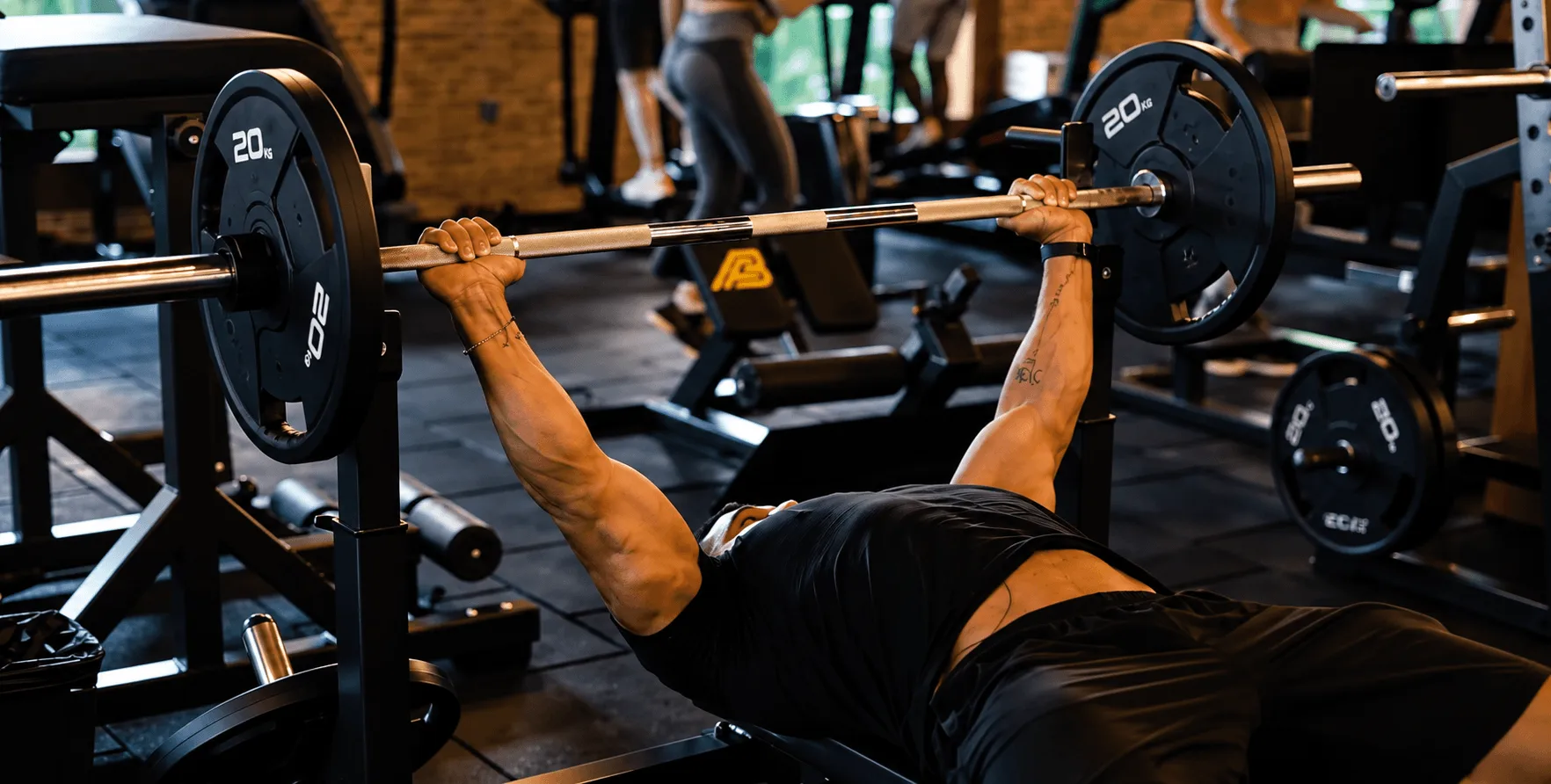
Barbell bench press
A classic compound movement for developing pressing strength while training the chest, shoulders and triceps.
Incline dumbbell press
The incline position places more emphasis on the upper portion of the chest while the dumbbells allow each side to work independently.
Back exercises
Lat pulldown
A practical way to train the lats and develop vertical pulling strength.
Seated cable row
A horizontal pulling movement that trains the back while allowing you to control the resistance throughout the movement.
Shoulder exercises
Dumbbell shoulder press
A compound pressing movement that trains the shoulders while also involving the triceps.
Dumbbell lateral raise
An isolation exercise that focuses on the lateral deltoids and complements your pressing movements.
Arm exercises
Dumbbell biceps curl
A simple way to train the biceps directly after your larger pulling movements.
Cable triceps pushdown
An accessible isolation exercise for the triceps that works well toward the end of an upper body session.
The exact exercise selection can vary, but the principle stays the same: combine compound movements with targeted isolation work.
A complete upper body workout routine
Here's a practical upper body workout routine you can use at the gym.
Exercise | Sets | Reps | Rest |
Band pull-aparts | 1–2 | 12–15 | 30–60 sec |
Barbell bench press | 3–4 | 6–8 | 2–3 min |
Lat pulldown | 3 | 8–10 | 2 min |
Incline dumbbell press | 3 | 8–10 | 90–120 sec |
Seated cable row | 3 | 8–12 | 90–120 sec |
Overhead press | 2–3 | 6–10 | 90–120 sec |
Dumbbell lateral raise | 2–3 | 12–15 | 60–90 sec |
Cable fly | 2–3 | 10–15 | 60–90 sec |
Face pull | 2–3 | 12–15 | 60–90 sec |
Biceps curl | 2–3 | 10–15 | 60–90 sec |
Triceps pushdown | 2–3 | 10–15 | 60–90 sec |
You can adjust the number of sets based on your experience, training schedule and recovery.
For strength-focused training, heavier loads are useful. For muscle growth, a broader range of loads can work when the overall training stimulus is appropriate. Research also shows that multiple resistance-training approaches can produce hypertrophy, while heavier loads are particularly useful for maximizing strength.
How many times a week should you train your upper body?
There isn't one frequency that works for everyone.
Your ideal schedule depends on your total training volume, experience, goals and how well you recover. An upper/lower split is one straightforward option:
- Monday: Upper body
- Tuesday: Lower body
- Wednesday: Rest
- Thursday: Upper body
- Friday: Lower body
- Weekend: Rest or active recovery
Training a muscle more frequently isn't automatically better if your total weekly volume is already accounted for. Research suggests frequency can be adjusted according to individual preference when training volume is similar.
For general health, adults are also advised to include muscle-strengthening activity on at least two days each week, covering all major muscle groups.
Continue reading: Gym chest workout: Build strength and muscle with a smarter routine
How to make your upper body workout more effective
Progress gradually
When you can complete your prescribed repetitions with good form, consider increasing the weight, adding a repetition or increasing your training volume.
Track your workouts
Record your exercises, weights and repetitions. If you aren't tracking your training, it's harder to know whether you're actually progressing.
Keep your technique consistent
Don't turn a controlled biceps curl into a full-body movement just to lift a heavier dumbbell.
Balance pushing and pulling
A strong upper body needs more than a big bench press. Include both horizontal and vertical pushing and pulling movements across your program.
Give your muscles time to recover
Training harder isn't always training better. Recovery gives your body the opportunity to adapt to the work you've done.
Common upper body workout mistakes
A few habits can make your training less effective:
- Doing several pressing exercises without enough pulling work
- Starting with biceps curls before your compound movements
- Using excessive weight and losing control of the movement
- Changing your entire workout every week
- Adding weight before you've mastered your technique
- Treating every set as a test of how heavy you can lift
You don't need a complicated program. You need one you can execute well and progress over time.
Train your upper body at Body Factory Bali
A good program gives you the structure. The right training environment gives you the space and equipment to execute it.
At Body Factory Bali, you can build your upper body sessions around strength training, free weights and high-quality gym equipment, with experienced coaches available when you want extra guidance.
Whether you're working towards more strength, more muscle or simply a stronger, more capable body, train with purpose and keep progressing.
Ready to put your upper body workout into practice?
FAQ
Can I do an upper body workout every day?
Not usually. Give your muscles time to recover between sessions, especially after high-volume or high-intensity training.
How many exercises should I do in an upper body workout?
Around 6–8 exercises is a practical range. Combine compound lifts with targeted isolation work based on your goals.
Can I do cardio after an upper body workout?
Yes. Add cardio after lifting if it fits your goals. Keep the intensity and duration manageable so it doesn't affect recovery.
Does an upper body workout burn calories?
Yes. Resistance training burns calories, but the amount depends on your body size, workout intensity, exercises and duration
How long should an upper body workout be?
Around 45–75 minutes is enough for most sessions. Focus on quality work, not spending more time in the gym.