
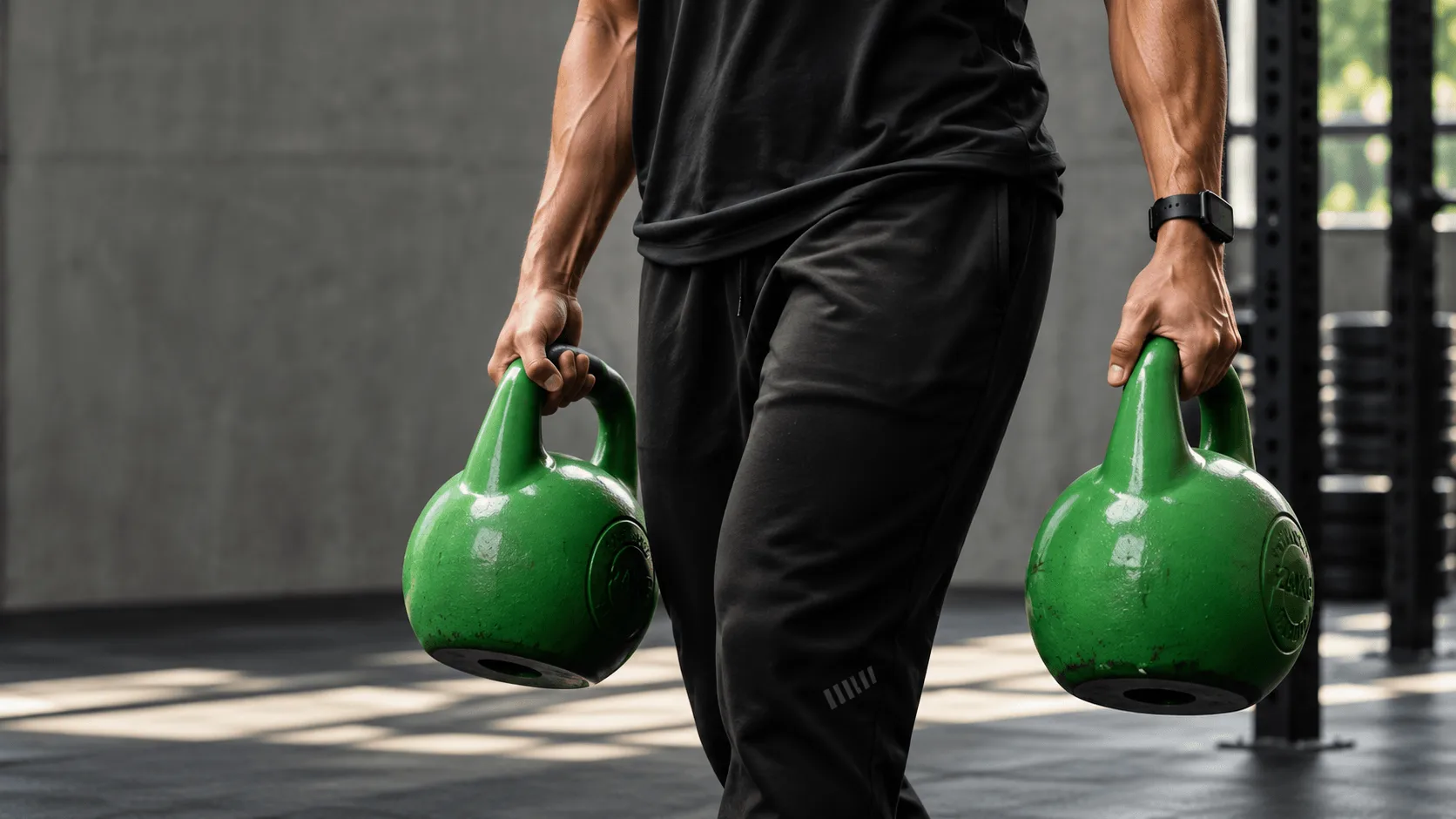
The farmers carry looks simple: pick up two weights and walk.
But in HYROX, you reach it after 6 km of running and five completed stations. At that point, grip strength is only part of the challenge. You need the strength to hold the load, the core stability to stay controlled, and the endurance to keep moving when fatigue sets in.
This guide breaks down the farmers carry workout, from proper technique and effective exercises to practical ways to build the strength and endurance HYROX demands.
What is a farmers carry workout?
A farmers carry workout is a loaded carry exercise where you hold a weight in each hand and walk for a set distance or time. It looks straightforward, but the challenge comes from maintaining control as the load gets heavier or the distance gets longer.
The movement trains several qualities at once, including:
- Grip and forearm strength from holding the weights
- Core strength and stability as you resist movement through your torso
- Posture as you maintain an upright position under load
- Lower-body strength and endurance as you keep walking
- Full-body coordination as you stabilize the weight with every step
For HYROX athletes, that combination makes the farmers carry more than a simple strength exercise. It teaches you to move with load while staying strong and controlled, which is exactly what you need when fatigue starts to build.
Continue reading: Everything you need to know about HYROX gear
Why farmer carries matter for HYROX
The HYROX Farmers Carry is only 200 meters, but the challenge is keeping your pace and position under load. By the time you reach this station, you have already spent energy running and completing other movements, so raw grip strength is only part of the equation.
Training the Farmers Carry helps you develop the qualities that matter when you have to keep moving with heavy kettlebells in your hands:
- Grip strength: Hold the kettlebells without your grip becoming the limiting factor.
- Core stability: Keep your torso controlled instead of letting the load pull you from side to side.
- Posture: Maintain an efficient position as fatigue builds.
- Strength endurance: Sustain force over the full distance rather than relying on short bursts.
- Walking efficiency: Take controlled, consistent steps without wasting energy.
The bigger goal is to make the carry more efficient. You want enough strength to handle the load, enough endurance to maintain your pace, and enough control to arrive at the next station ready to work.
How to do the Farmers Carry correctly
The Farmers Carry is simple on paper: pick up the kettlebells and walk. The challenge is maintaining control from the first step to the last, especially when fatigue starts to affect your grip and posture.
1. Set your position
Stand between the kettlebells with your feet about hip-width apart. Keep your chest open and spine neutral before you lift.
2. Lift with control
Hinge at your hips and bend your knees to pick up the kettlebells. Brace your core and drive through your feet to stand tall.
3. Lock in your posture
Once standing, keep your shoulders controlled, arms straight, and torso upright. Avoid leaning backward or allowing the weights to pull you from side to side.
4. Walk with purpose
Take short, controlled steps and maintain a consistent pace. Keep the kettlebells close to your body, but don't let them rest against your body or swing your arms.
5. Stay composed under fatigue
As the carry gets harder, your first instinct may be to rush. Don't. Keep your breathing controlled, maintain your posture, and focus on efficient steps.
The goal isn't simply to carry the weight. It's to carry it efficiently while using as little unnecessary energy as possible.
What is the HYROX Farmers Carry weight?
Knowing the weight you’ll carry in your HYROX division is essential for training with the right load. Here’s what you need to know about the official Farmers Carry weights by division.
Division | Weight per hand | Total weight |
Women Open | 16 kg | 32 kg |
Women Pro | 24 kg | 48 kg |
Men Open | 24 kg | 48 kg |
Men Pro | 32 kg | 64 kg |
Farmers carry workout for HYROX
To prepare for the HYROX Farmers Carry, your training should go beyond simply picking up the competition weight and walking 200 meters. Build your capacity progressively, then add fatigue and race-specific conditions as your strength improves.
Training level | Workout | Rest | Main focus |
Beginner | 3 × 30–40 m Farmers Carry | 60–90 sec | Build grip strength and learn efficient technique |
Intermediate | 4 × 50–60 m Farmers Carry | 60 sec | Develop carry strength and endurance |
Race-specific | 4 rounds: 1 km run + 100 m Farmers Carry | 2–3 min | Practice carrying under race-like fatigue |
Start with a load that lets you maintain strong posture and consistent steps throughout each set. As you improve, progress by increasing the load or distance, reducing rest, or adding the carry after running.
For HYROX preparation, the goal is not to make every session a max-effort test. Build the capacity to pick up the weight, move efficiently, and keep your technique together when fatigue sets in.
Continue reading: HYROX training guide: How to prepare for race day properly
Farmers carry exercises and variations
Exercise | How it works | Best for | Example |
Dumbbell farmers carry | Hold a dumbbell in each hand and walk under control. | Building general grip and carry strength | 3–4 × 30–60 m |
Kettlebell farmers carry | Carry a kettlebell in each hand while maintaining an upright posture. | Race-specific carry practice | 3–4 × 50–100 m |
Suitcase carry | Carry one weight on one side while keeping your torso level. | Core stability and unilateral strength | 3 × 30–40 m per side |
Heavy farmers carry | Use a heavier load for shorter distances with full control. | Max strength and grip capacity | 4–5 × 20–30 m |
For HYROX athletes, kettlebell carries are the most direct way to practice the competition movement, while the other variations can build supporting grip, core, and unilateral strength.
How to add farmers carry to your training
Farmers carry works best when it supports your wider HYROX training rather than becoming another max-effort session every week. The key is to vary the stimulus between strength, endurance, and race-specific work.
Training goal | How to program it | Example |
Build carry strength | Use heavier loads for shorter distances | 4 × 20–30 m |
Improve grip endurance | Use a moderate load for longer carries | 3–4 × 50–80 m |
Train under fatigue | Add Farmers Carry after running or another HYROX movement | 1 km run + 100 m carry |
Practice race pace | Use your competition weight and focus on consistent movement | 200 m continuous carry |
For most athletes, 1–2 Farmers Carry sessions per week is enough. Keep at least one session focused on quality rather than simply chasing heavier weights.
As your capacity improves, progress one variable at a time: increase the load, extend the distance, add total volume, or reduce rest. This keeps the movement challenging without turning every workout into a test of how long you can hold on.
Common Farmers Carry mistakes
The Farmers Carry is simple, but small technique errors can waste energy and make the station harder than it needs to be.
Going too heavy
If the load forces you to lean, shrug, or lose your grip early, it is too heavy for the current goal. Build capacity before chasing heavier weights.
Taking overly long steps
Long strides can make it harder to control the kettlebells and maintain your posture. Keep your steps short, smooth, and consistent.
Shrugging the shoulders
Avoid trying to hold the kettlebells higher by constantly shrugging your shoulders. Keep them controlled and let your arms hang naturally.
Leaning from side to side
Your torso should stay stable as you walk. Excessive movement from side to side usually means the load or pace is compromising your control.
Rushing the carry
Moving faster isn't always more efficient. Find a pace you can sustain without your grip, breathing, or posture falling apart.
Only training when fresh
A competition Farmers Carry comes after other demanding work. Once you've built a solid strength base, include carries after running or other exercises to practice staying efficient under fatigue.
Train for HYROX at Body Factory Bali
A strong Farmers Carry starts with strong fundamentals.
At Body Factory Bali, you can take that training further with a dedicated HYROX training center in Canggu, built for athletes focused on race-ready performance. From competition-style equipment and functional training space to the strength and conditioning work that supports every HYROX station, BFB gives you the environment to build real race day capacity.
Whether you're preparing for your first HYROX or working to improve your next performance, train your strength, endurance, and movement under one roof.
Train for HYROX at Body Factory Bali
FAQ
What should I pair farmers carry with?
Pair Farmers Carry with exercises that complement your HYROX goals, such as sled pushes, sled pulls, running, lunges, and wall balls. You can also use carries as a finisher after a strength session.
Should I use straps for farmer carries?
If your goal is to improve grip strength, train without straps. Straps can reduce the demand on your grip, so they may be useful in specific strength-training situations but are generally unnecessary for race-specific carry work.
Can I use chalk at the HYROX farmers carry?
Yes, but only the chalk provided at the station. HYROX permits chalk at the farmers carry and sled pull only. Bringing your own chalk, or using chalk at other stations, can result in a 2-minute penalty.
Does the farmers carry improve running performance?
Farmer carries are not a replacement for running, but they can strengthen your trunk and improve your ability to maintain posture while moving under load. For HYROX athletes, that can complement the running-specific work in your program.
How do I improve my farmers carry without increasing the weight?
You have several options: increase the distance, add another set, reduce rest time, improve your walking pace, or perform the carry after another exercise. Progress does not always have to mean adding more weight.