
If you want stronger, more defined abs, treat them like any other muscle group.
That means choosing exercises that train your abs directly, using resistance you can control and gradually increasing the challenge as you get stronger.
You don't need endless crunches or hundreds of repetitions. A well-designed abs workout at the gym can combine weighted exercises, cable movements and bodyweight training to give your abdominal muscles a consistent stimulus.
The goal is simple: train your abs directly, progress your exercises and give your body enough time to recover.
What makes an effective abs workout at the gym?
The best ab workout isn't necessarily the one with the most exercises.
Instead, choose movements that allow you to train your abs through a controlled range of motion and gradually increase the difficulty.
A gym ab workout can include:
- Loaded abdominal flexion, such as cable and weighted crunches
- Dynamic leg-raise movements, which challenge the abs while controlling the pelvis
- Sit-up variations, which increase the challenge through positioning and range of motion
- Machine-based ab training, which provides a stable setup for resistance
- Oblique-focused movements, such as cable woodchops
You don't need all of them in one workout. Choose a few movements that you can perform well and progress consistently.
Continue reading: Exercises for wider shoulders: Best workout to build broader delts
7 effective ab exercises to add to your gym workout
Now that you know what a good core session should cover, it's time to choose the movements. You don't need every ab exercise in the gym. You need the ones you can perform well, load progressively, and keep challenging as you get stronger.
1. Cable crunches
Cable crunches are one of the easiest ways to add adjustable resistance to direct abdominal training.
The cable allows you to increase the load over time instead of relying on increasingly high repetitions.
How to do it: Set the cable at a high position and kneel in front of the machine. Hold the rope beside your head, brace your core and curl your torso downward, bringing your ribs toward your pelvis. Return slowly without pulling the rope with your arms.
Recommended: 3 sets of 10–15 reps
Targets: Abs
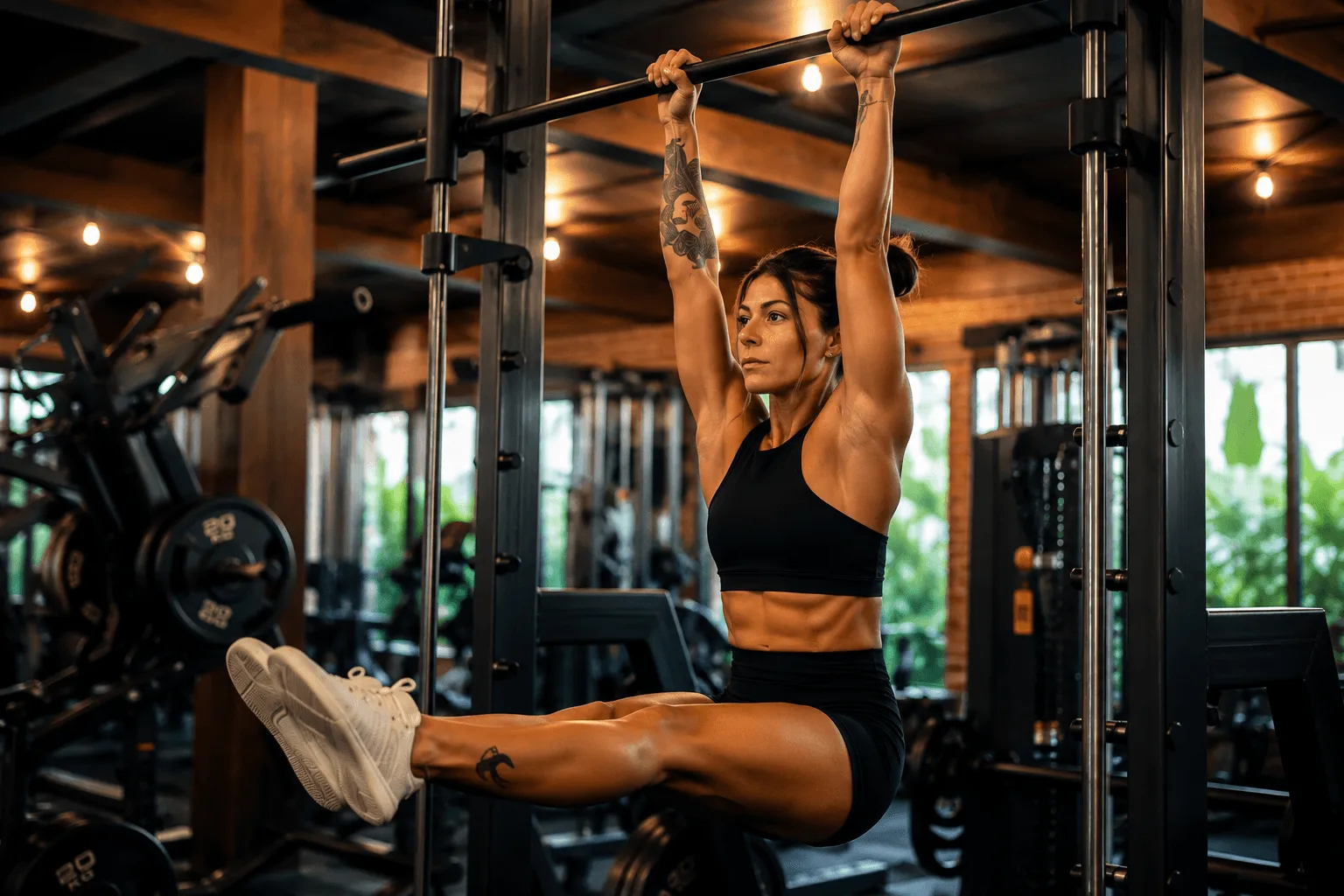
2. Hanging leg raises
Hanging leg raises train your abs while requiring you to control your hips and pelvis.
If straight-leg raises are too difficult, begin with bent knees and progress as your strength improves.
How to do it: Hang from a pull-up bar and establish a controlled starting position. Brace your abs and raise your legs without swinging. Lower them slowly before repeating.
Recommended: 3 sets of 8–12 reps
Targets: Abs and hip flexors
3. Decline sit-ups
A decline bench increases the challenge of a traditional sit-up by changing your body position and range of motion.
Once bodyweight repetitions become manageable, you can hold a plate against your chest to add resistance.
How to do it: Secure your feet, lower your torso under control and sit up without using momentum. Keep the movement deliberate throughout the full range you can control.
Recommended: 2–3 sets of 8–12 reps
Targets: Abs
4. Weighted crunches
Weighted crunches are useful when regular crunches no longer provide enough resistance.
Adding a manageable load gives you another way to progressively challenge your abs.
How to do it: Hold a weight against your chest and perform a controlled crunch. Focus on shortening your torso through your abdominal muscles rather than swinging or rushing through the movement.
Recommended: 2–3 sets of 10–15 reps
Targets: Abs
5. Ab machine crunches
Ab machines provide a stable setup and make it easy to adjust the resistance.
They can be particularly useful when you want to focus on your abs without having to stabilize the rest of your body as much.
How to do it: Adjust the machine to fit your body, select a manageable weight and work through a controlled range of motion. Focus on contracting your abs rather than moving the weight with your hips or arms.
Recommended: 3 sets of 10–15 reps
Targets: Abs
6. Cable woodchops
Cable woodchops add an oblique-focused movement to your ab workout.
They train your trunk through rotation and can provide variety alongside flexion-based exercises.
How to do it: Set the cable at an appropriate height and stand sideways to the machine. Hold the handle with both hands and move it across your body under control. Avoid simply swinging the weight from one side to the other.
Recommended: 2–3 sets of 10–12 reps per side
Targets: Obliques and core
7. Plank variations
Planks are different from most ab exercises because they challenge you to maintain tension rather than repeatedly flex your torso.
They can still complement direct abdominal training, particularly when used as a finisher.
How to do it: Start in a stable plank position and brace your abs. Keep your body aligned and maintain the position without allowing your hips to sag or rise.
Recommended: 2–3 sets of 30–60 seconds
Targets: Abs and core
Continue reading: Gym chest workout: Build strength and muscle with a smarter routine
A sample abs workout at the gym
You don't need to train your abs for an hour.
Three to five exercises can provide plenty of direct work when you choose them well and progressively challenge the movements.
Try this routine after your main workout:
Exercise | Sets | Reps |
Cable crunches | 3 | 10–15 |
Hanging leg raises | 3 | 8–12 |
Weighted crunches | 3 | 10–15 |
Cable woodchops | 2 | 10–12 each side |
Ab machine crunches | 2 | 10–15 |
Rest around 60–90 seconds between sets, or longer if you need it to maintain good form.
How to adjust the workout
Beginner: Start with 2 sets per exercise and focus on learning the movements. Use bent-knee hanging raises if straight-leg raises are too difficult.
Intermediate: Follow the full routine and begin adding resistance when you can complete the top end of the rep range with good technique.
Advanced: Increase the load or choose a harder variation when the current exercise becomes too easy. You don't need to endlessly increase the number of repetitions.
How to progressively overload your abs
Your abs respond to training like other muscles: they need a consistent stimulus that becomes more challenging over time.
Add resistance. When you can comfortably complete your target repetitions, increase the load slightly on exercises such as cable crunches, weighted crunches or ab machines.
Improve your range of motion. Use the fullest range you can control without allowing your technique to break down.
Make the exercise harder. If adding weight isn't practical, use a more demanding variation or increase the difficulty of the movement.
Control every repetition. Don't let momentum take over as the set becomes difficult. A slower, controlled repetition can keep the focus where you want it.
Progress doesn't have to mean doing more reps. It can mean doing the same number of reps with better control and more resistance.
How often should you train your abs?
You don't need to train your abs every day.
For most people, 2–3 focused ab sessions per week can be enough, particularly when your overall training already includes exercises that involve your trunk.
Think about your full training week rather than treating ab work in isolation.
Heavy compound exercises can already place demands on your trunk, so give your abs enough time to recover between hard direct sessions.
The goal is to create a training stimulus you can consistently recover from and build on.
How to build more defined abs
Building the abdominal muscles and revealing them are two different parts of the process.
Direct ab training can help you develop stronger, more muscular abs. But how visible they are also depends on your overall body composition.
If definition is your goal:
- Train your abs consistently
- Progress your exercises over time
- Keep strength training and regular activity in your routine
- Support your goal with appropriate nutrition
- Give recovery enough attention
You don't need to perform hundreds of crunches or use extreme dieting strategies.
Build the muscle, support your overall training and give the process time.
Common mistakes when training your abs at the gym
Good ab training isn't about doing more. It's about doing better. A few common mistakes can turn a productive set into a lot of movement with very little tension where you want it.
Using momentum
Swinging through hanging leg raises or rushing through crunches might help you finish the set, but it also takes tension away from your abs.
Slow the movement down and stay in control. If you can't control the exercise, reduce the weight or choose an easier variation.
Going too heavy
More weight doesn't automatically mean better results. If you're using your arms, hips, or momentum to move the load, your abs aren't getting the stimulus you're after.
Choose a weight that lets you complete every rep with solid technique.
Chasing high reps
You don't need 50, 100, or 200 reps to train your abs effectively. Once an exercise becomes easy, increase the challenge rather than endlessly increasing the rep count.
Add resistance, slow down the tempo, or move to a more demanding variation.
Only training one type of movement
Crunches can be useful, but you don't need to build your entire ab routine around one exercise.
Combine flexion-based movements with exercises that challenge your obliques and trunk control.
Expecting ab exercises to burn belly fat
This is one of the biggest misconceptions around ab training. You can strengthen and develop your abdominal muscles, but you can't choose where your body loses fat.
If definition is your goal, your training needs to work alongside your overall nutrition, activity level, and body-composition goals.
Train your abs with purpose. Don't confuse more work with better work.
Train your abs in an environment built for performance
Building stronger, more defined abs takes more than adding a few crunches to your workout. It also takes the right equipment and environment to train consistently and keep progressing.
At Body Factory Bali, you'll find everything you need for your abs workout at the gym, from cable stations and ab machines to free weights and dedicated training spaces, giving you plenty of ways to challenge your core as you get stronger.
If you'd like extra support, our experienced coaches are available to help you refine your technique, structure your workouts, and train with more purpose.
Still deciding? Try our Day Passes and get full access to our premium training facilities, high-quality gym equipment, and one of Bali's most complete recovery areas. Experience the space, train your way, and see what sets Body Factory Bali apart.
FAQ
Can ab workouts burn belly fat?
No. Ab exercises build your abs, not specifically burn stomach fat. Fat loss comes from your overall energy balance, training, and nutrition.
How long does it take to build stronger abs?
Expect progress over weeks and months, not days. Train consistently, progressively increase the challenge, and give your abs time to recover.
Are ab machines effective for building abs?
Yes. Ab machines let you add and control resistance, making them useful for progressive overload. Use a weight you can control without relying on momentum.
Should I do abs before or after my workout?
After your main workout. A tired core can affect your bracing and performance during heavy lifts such as squats and deadlifts.
Why don't I feel my abs during ab exercises?
Check your form first. Slow down, reduce the weight, and stop using momentum. If you still can't keep tension on your abs, switch to an easier variation.